CannabCo’s Odourless OG™ is now in more than 300 Ontario cannabis stores, and the company’s announcement points to independent cannabis odour testing by Scentroid. Here is a look at how that testing works and why measured data matters when a product’s main selling point is how it smells.
Earlier this month, CannabCo Pharmaceutical Corp. announced that its Odourless OG pre-rolls are stocked, ordered or onboarding at more than 300 licensed retailers across Ontario, only a few months after launch. CannabCo developed the product through selective breeding and cultivation, with no added fragrances or masking agents.
In that announcement, CannabCo shared that “independent comparative testing by Scentroid found that CannabCo’s cannabis produced substantially less measured odour than regular cannabis under controlled conditions, including during combustion.” We were glad to be part of that work, and congratulations to the CannabCo team on the launch.
A lot of people have asked how you actually measure something as subjective as smell. So here is the science behind cannabis odour testing, and how the same approach works for any product or facility.
Why odour claims need independent testing
Calling a product “odourless” is a bold claim. Retailers, consumers and regulators all want to know it holds up, and opinions like “it smells less” are hard to defend. What does hold up is a repeatable measurement from a third party that follows a recognized standard.
That is what CannabCo asked us for. The goal was to compare their low odour strain against a regular strain under the same conditions, and put a number on the difference.
How cannabis odour testing works
Odour is not a single chemical. Cannabis smell comes from a mix of terpenes and other volatile compounds, and the human nose responds to that mix in ways a single gas sensor can’t fully capture. That is why the most trusted way to measure odour still uses people under strict lab controls. We call this olfactometry.
1. Controlled sample preparation
A fair comparison starts with identical sample conditions. For this study our team designed and built custom sampling setups. That let us test each strain the same way in three scenarios people actually care about:
- Storage: how much odour the product gives off sitting in a sealed container
- Vaporization: odour released when the product is heated without burning
- Combustion: odour released when the product is burned
We controlled temperature, airflow and humidity for every sample. Odour samples went into odour-free PTFE sample bags filled with certified clean air. We also ran duplicate tests to confirm the results were consistent.
2. Dynamic olfactometry to EN 13725
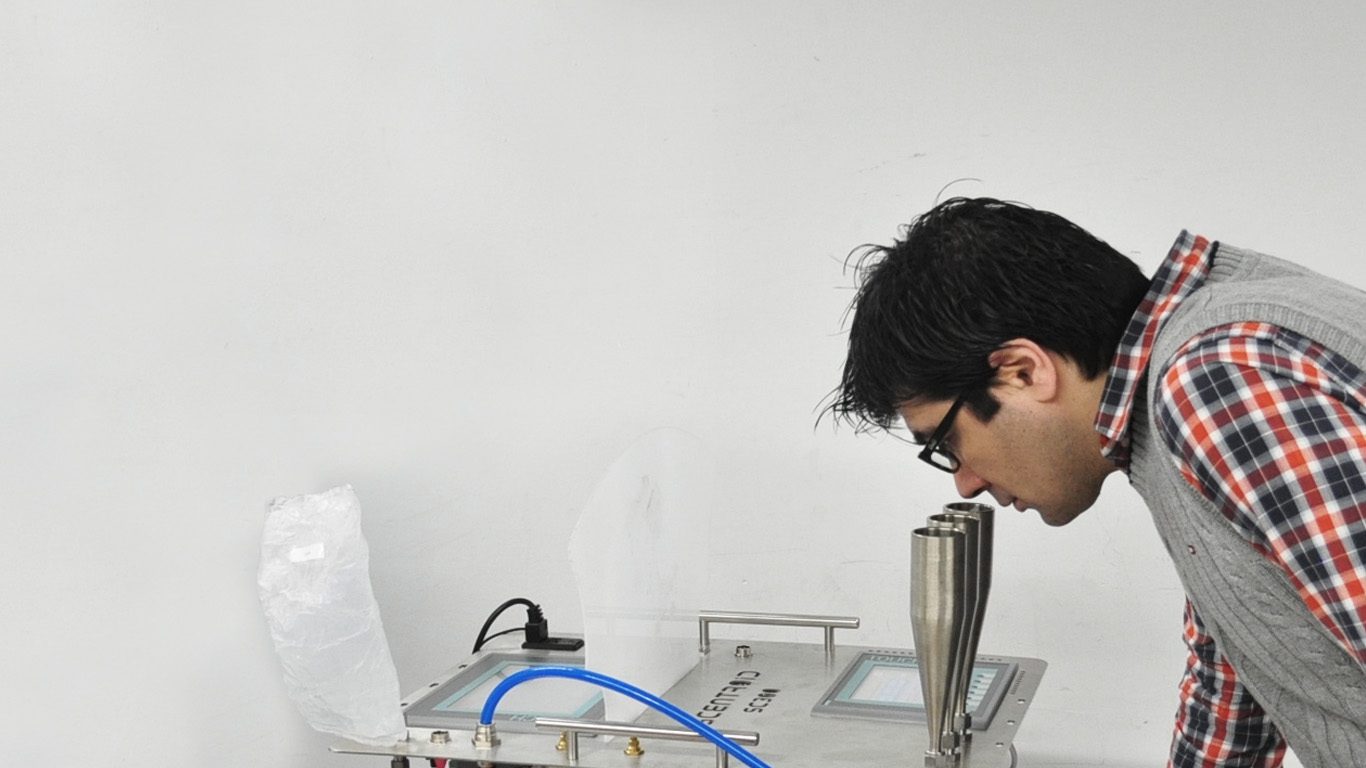
Our team analyzed each sample with a Scentroid olfactometer following EN 13725, the European standard for measuring odour concentration. Trained and screened panelists sniff the sample at a series of precise dilutions with clean air. It starts very dilute and gets stronger until each panelist can reliably detect it.
The result comes out in odour units per cubic metre (OU/m³). That number tells you how many times you need to dilute a sample before nobody can smell it. The higher the number, the stronger the odour. Because the method is standardized, you can compare results between products, labs and over time.
3. Hedonic tone
Strength is only half the story. Two odours at the same concentration can feel very different depending on whether they are pleasant or offensive. Hedonic tone measures this on a nine point scale from -4 (offensive) to +4 (very pleasant), with panelists rating each sample at matched concentrations.
This matters because people complain far more about an unpleasant odour than a neutral one, even at the same strength.
What the cannabis odour testing showed
As CannabCo has shared publicly, the testing found their cannabis produced substantially less measured odour than regular cannabis. That held under controlled conditions, including during combustion. The detailed results belong to CannabCo, so we won’t go further than that here.
Combustion is the toughest test for any low odour product, since burning creates smoke odour of its own. That makes the reduction CannabCo saw during combustion especially notable.
Product odour testing beyond cannabis
The same testing approach works for any product where smell affects buying decisions, complaints or compliance. We regularly help companies with:
- Consumer products, packaging and building materials
- Odour neutralizers, masking agents and air filtration products
- Fragrance and perfume development
- Food and beverage processing
- Comparing before and after results for odour control equipment
Scentroid’s cannabis odour testing services
For the cannabis industry, product testing is only one piece. Grow and processing facilities also deal with neighbour complaints and municipal odour bylaws. Our cannabis odour monitoring services cover the full picture:
- Product odour testing: comparative odour concentration and hedonic tone testing to EN 13725 and ASTM E679
- Facility emission sampling: odour and air quality sampling at exhausts, greenhouses and perimeters
- Odour impact assessments: dispersion modelling to show how odour travels into the community
- Continuous monitoring: perimeter monitors and SIMS3 to track odour events and manage complaints
- In-house testing: olfactometers like the SS600 odour laboratory for companies that want to build their own odour lab

Frequently asked questions
What is an odour unit (OU/m³)?
One odour unit per cubic metre is the concentration at which half of a trained panel can just detect an odour. For example, you would need to dilute a 1,000 OU/m³ sample 1,000 times with clean air to bring it down to that detection threshold.
What does “odourless” mean when it comes to cannabis?
Every plant material has some measurable odour. A low odour or “odourless” product is one that gives off far less odour than a typical product under the same conditions. Olfactometry puts a number on that difference, so brands like CannabCo can back up their claims with independent data.
Can Scentroid test my product or facility?
Yes. We provide cannabis odour (or odor, as it’s spelled in the US) testing for producers, processors and brands, along with product odour testing for many other industries. We can run projects in our lab or on site.
Have a product or facility that needs odour testing? Contact our team or call 1.888.988.4337 to talk about your project.