
Applications
Built for the Environments That Cannot Wait. XIcore platforms operate in forward positions, denied environments, and complex terrain — delivering Extended Intelligence where conventional systems cannot be deployed, cannot survive, or cannot keep pace.
Defense and Military
Persistent battlespace awareness, counter-UAS, force protection, CBRN early warning.
Reconaissance
Distributed unattended ground sensor networks for long-duration area awareness.
Critical Infrastructure
Perimeter monitoring for energy, utilities, communications, and data facilities.
Border & Coastal Security
Wide-area sensor networks for border and maritime surveillance.
Search & Rescue
Distributed sensing networks enabling rapid area coverage in complex terrain.
Disaster Response
Deployable CBRN hazard mapping and post-event environmental intelligence.
Industrial Safety
Continuous multi-sensor monitoring of hazardous process environments.
Major Events & Public Safety
Venue-scale CBRN and threat monitoring for mass-gathering security.
EXTENDED INTELLIGENCE WHEN EVERY MINUTE COUNTS
Search and rescue and disaster response demand rapid deployment, wide-area coverage, and real-time CBRN intelligence where no infrastructure exists. XIcore's self-organizing mesh requires no pre-configuration as nodes are deployed and operational within minutes.
DEFENCE AND MILITARY
Persistent Awareness
Military operations demand continuous situational awareness across wide areas, in environments where GPS is jammed, communications are degraded, and the threat picture includes airborne UAS, dismounted personnel, vehicle movement, artillery, and chemical hazards simultaneously.
XIcore payloads deploy flexible multi-transport connections to stay online under severe spectral congestion, converting hundreds of scattered data triggers into real-time threat maps.
OPERATIONAL OUTCOMES
Persistent Coverage
24/7 coverage across contested sectors.
Multi-Threat
Tracks personnel, vehicles, drone systems, and gas triggers concurrently.
Counter-UAS
Cross-fuses acoustics arrays with passive RF to isolate flight nodes.
Counter-Battery
Seismic time-difference-of-arrival isolates blast targets.
Force protection
Integrated tactical chemical warning flags.
Low logistics burden
Weeks of autonomous solar-cell operation.
LONG-DURATION RECONAISSANCE
Situational Awareness
Reconnaissance demands persistent, wide-area sensing over extended time horizons, with minimal operator workload and minimal logistical footprint. XIcore’s distributed sensor architecture is purpose-built for this mission: rapidly deployed, self-sustaining, and autonomously intelligent.
The XIcore Engine reduces the cognitive burden on reconnaissance personnel by delivering confidence-scored, fused threat tracks rather than raw sensor feeds. Operators focus on decisions, movement, communication, escalation, not data management.
STRUCTURAL PARAMETERS:
Unattended ground sensors
Nodes operate without human configuration for months, caching threat pathways.
Low signature
Completely passive operation emits no detectable RF energy, remaining fully hidden.
GNSS-denied operation
High-precision crystal oscillators transfer timing across the grid without GPS requirements.
MAJOR EVENTS AND PUBLIC SAFETY
Validated at the world's largest gatherings
The most demanding test of a distributed sensing platform is not a battlefield, it is a venue hosting 80,000 people with saturated RF spectrum, dense crowds masking chemical and acoustic baselines, and zero tolerance for false positives that trigger mass panic.
The most demanding test of a distributed sensing platform is not a battlefield, it is a venue hosting 80,000 people with saturated RF spectrum, dense crowds masking chemical and acoustic baselines, and zero tolerance for false positives that trigger mass panic.
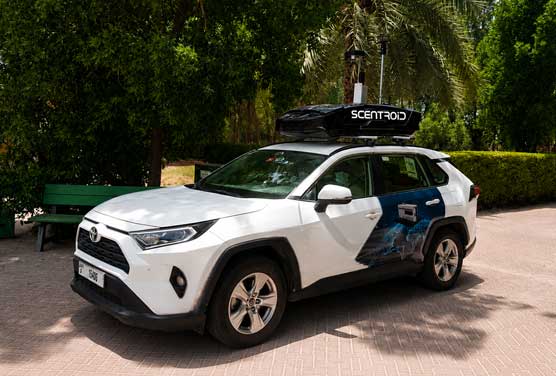
FIFA WORLD CUP 2022 · QATAR
US20 nodes were deployed at World Cup venues for concurrent counter-UAS and CBRN monitoring. The C-UAS capability fused visual detection with passive RF interception to detect, classify, and geolocate unauthorized UAS. CBRN sensors monitored chemical threats across venue perimeters, validating contested-RF resilience with tens of thousands of spectator devices active simultaneously.
FIFA WORLD CUP 2026 · CANADA
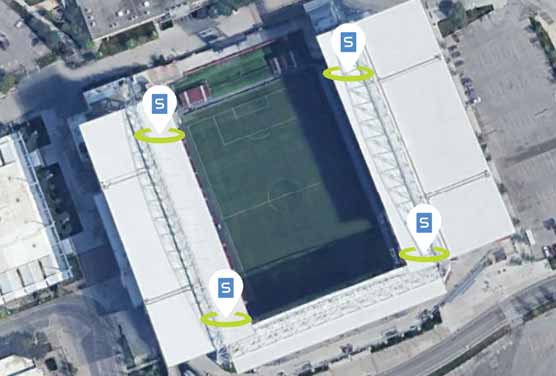
Scentroid monitored CBRNE threats inside Canadian World Cup stadiums, with sensor nodes positioned at each corner of the venue interior. The multi-node configuration enabled real-time triangulation of chemical threat sources, providing early detection and localization before concentrations reached hazardous levels.
In both deployments, XIcore Engine maintained full operational capability in contested RF environments where conventional IoT and cellular-dependent systems experienced significant degradation, validating the architecture’s resilience under real-world spectrum saturation.
Protecting what cant be replaced
CRITICAL INFRASTRUCTURE
XIcore’s distributed sensing changes the economics of perimeter protection. A network of nodes provides overlapping acoustic, RF, seismic, and CBRN coverage across an entire facility, detecting aerial intrusion, ground breach, electromagnetic reconnaissance, and chemical hazard simultaneously.
Perimeter breach detection
Acoustic, seismic, and RF fusion detects physical intrusion and the reconnaissance that precedes it.
UAS threat monitoring
Persistent RF and acoustic coverage detects unauthorized drone activity with operator geolocation
Chemical hazard alerting
CBRN sensing provides early warning of industrial accident, environmental release, or deliberate attack with 3D source mapping.
A Division of Scentroid IDES Canada Inc.
Stouffville, Ontario, Canada
© 2026 IDES Canada Inc. All rights reserved.
PROUDLY CANADIAN · DUAL-USE TECHNOLOGY